Beyond the Trulli: Unlocking the Baroque and Rococò Heart of Martina Franca
This very special local travel guide uncovers the rich history of the masserie in Puglia and how 18th-century agrarian wealth transformed Martina Franca old town into a stage for grand Puglia Baroque architecture. Moving beyond rustic trulli, this deep cultural exploration highlights the top things to do in Martina Franca, from courtyard houses to the Palazzo Ducale Martina Franca. It serves as a fascinating treasure hunt through the hidden gems of Valle d’Itria Italy.
To many travelers planning a trip with a standard Puglia travel guide, Central Puglia’s Valle d’Itria is a landscape defined solely by its iconic, conical trulli houses and ancient olive groves. Yet, perched at 431 meters above sea level—almost the highest point in the valley—lies an urban anomaly that tells a completely different story. Martina Franca does not just sit within the Valle d’Itria; geographically and historically, it commands it, holding over half of the valley's territory. More importantly, it challenges the rustic narrative of the region, offering a sophisticated counterpoint of urban planning and architectural opulence that makes it one of the best towns to visit in Puglia.
To truly understand Martina Franca is to understand a unique socio-economic phenomenon: a tale of rural wealth transforming into urban prestige. Under the century-long rule of the Caracciolo dukes, a new agrarian bourgeoisie flourished. These twenty or so wealthy families grew very rich from the masserie—the fortified agricultural estates dotting the countryside. But they did not keep their fortunes in the fields. In a fierce display of social competition, they brought their wealth behind the city walls, transforming the medieval, winding streets into a high-stakes canvas of Rococò architecture, the final, most theatrical flourish of late-Baroque design.
As you pass through the historic gates of Martina Franca's old town, you will quickly realize why this destination is one of the ultimate hidden gems in Puglia. You are not just walking through a town; you are entering an open-air museum where rural enterprise meets urban aristocracy. Every twisted alleyway, hidden courtyard, and theatrical balcony is a clue in an architectural treasure hunt.
The History of Puglia Masserie: How Agricultural Wealth Shaped Urban Architecture
The standard narrative of the region's travel guides often separates the rural masseria from the urban palazzo. In Martina Franca, however, they are mirror images.
During the era of the Caracciolo duchy, a feudal reign spanning from 1507 to 1806, the local landowners didn't just build farms; they engineered self-sustaining agrarian micro-economies enabling them to accumulate considerable wealth. When these families sought to assert their dominance, they looked to the dense, medieval urban core of the old town.
Because space within the city walls was tightly constrained, architects had to innovate. They adapted the grand layout of the rural estate into the urban fabric, creating the famous case a corte (courtyard houses). Behind a singular, imposing street-facing portal lay a private courtyard, a grand staircase, stables, and living quarters—effectively cramming the functional opulence of a massive countryside estate into a tight medieval alley. Today these massive wooden portals offer a direct window into this historical architectural pivot.
Things to Do in Martina Franca: An Urban Treasure Hunt
To experience the best of Martina Franca's old town, look beyond the souvenir shops and elevate your eyes. The real history is carved into the limestone overhead. This curated itinerary highlights the essential stops defining the city's Rococò evolution. For an in-depth exploration of Martina Franca's hidden wonders, don't hesitate to request our complete, specialized guide.
1. Palazzo Ducale: The Seat of Power
Enter the historic center through the monumental Porta di Santo Stefano to find the Palazzo Ducale, the definitive symbol of the Caracciolo family's ambition. Initiated in 1668, this grand palace bridges late-Renaissance structural sobriety with the theatricality of the Baroque. Don't miss a look inside to explore the piano nobile (second floor). Here, the remarkably preserved frescoes by Domenico Carella offer a vivid look into aristocratic ideals across three distinct themed spaces: the Sala dell’Arcadia, depicting elegant scenes of courtly life; the Sala del Mito, featuring paintings inspired by Ovid’s Metamorphoses; and the Sala della Bibbia.
2. Basilica di San Martino: The Rococò Climax
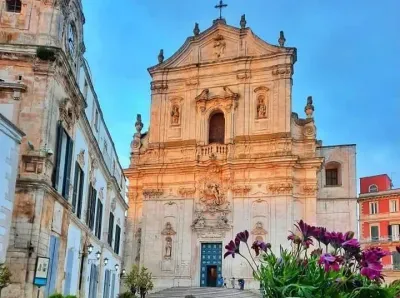
Your architectural treasure hunt culminates at the Basilica di San Martino, arguably one of the finest examples of Puglia Baroque architecture and considered the very symbol of the Barocco Martinese. Built in the mid-18th century, its towering facade is a masterpiece of movement, adorned with high-relief sculptures, twisting scrolls, and a prominent statue of Saint Martin sharing his cloak.
The interior marble work and sculptural elements carry the deep artistic DNA of the Kingdom of Naples. The master craftsmen who sculpted these altars worked in the exact creative circles as the artists responsible for Naples’ famed Veiled Christ, bringing world-class Neapolitan refinement to a hilltop town in Puglia.
3. Palazzo Ancona & Palazzo Carucci: Structural Geometry
As you navigate the sinuous medieval streets, look for Palazzo Ancona and Palazzo Carucci. These residences are masterclasses in architectural adaptation. Instead of forcing straight, rigid Roman lines onto the winding roads, Baroque architects twisted the facades of these palaces to match the curves of the alleyways. Notice the theatrical, undulating balconies and the intricate ironwork, as well as the magnificent stonework.
4. La Lama: The Spontaneous Counter-Narrative
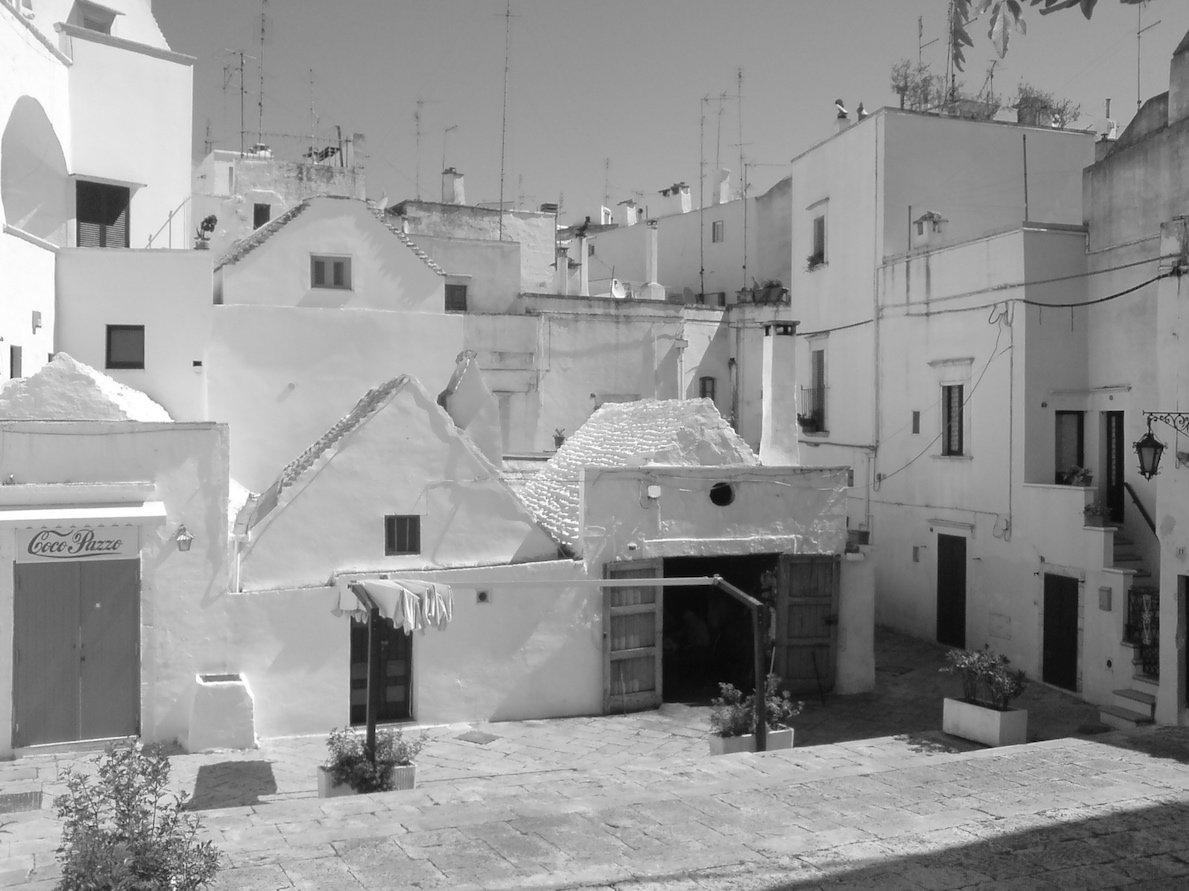
For a profound contrast to aristocratic opulence, walk toward the northern edge of the historic core to find La Lama. This neighborhood represents the spontaneous, medieval layout of the town before the Baroque boom. Characterized by narrow, winding alleys, steep slopes, and whitewashed tetti a pignon (pointed roofs), La Lama was built by the less affluent. It serves as a beautiful, quiet reminder of the city's ancient roots, where architecture was born out of raw necessity rather than social competition.
Embracing the Open-Air Museum
Martina Franca requires a slower pace of travel. It rewards the visitor who stops to inspect an apotropaic mask carved above a doorway, or who understands why a balcony curves outward (to accommodate the wide pannier skirts of 18th-century noblewomen).
By choosing to base your journey here, you are placing yourself at the intersection of Puglia’s agrarian grit and its highest artistic achievements. Step outside, leave the map (and smartphone) behind for a moment, look up at the limestone facades, and let the historical theater of Martina Franca unfold around you.